Monday, June 4, 2012

Hello Darlin'

Every time my great Aunt Leila and Uncle George came to NJ for a family gathering, Uncle George would greet me with a big "Hello Darlin'!" I just thought about that the other day and had to laugh as it seemed so out of character for someone who lived his entire life in the Bronx, NY. Thanks to Aunt Leila for saving oodles of family memorabilia, I thought it would be nice to honor Uncle George for his military service during World War I.


On May 17, 1918, George received his orders to report for active duty at Newport, RI. He was 27 years old.


He had a slight build and was only 5' 5-1/2" tall. 


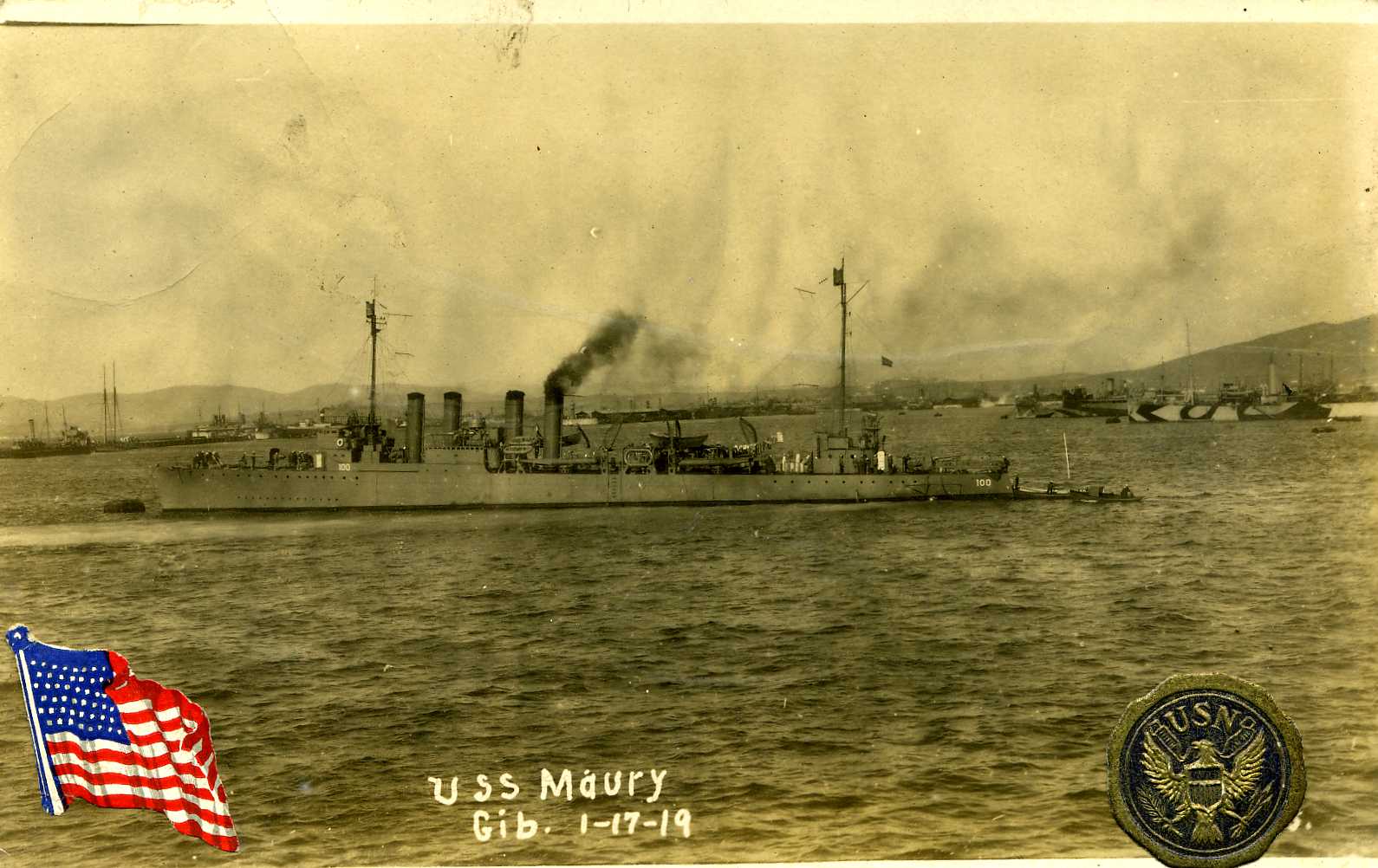
Dated Feb. 1, 1919, Gibraltar. "My home for the present. U.S.S. Maury, Torpedo Boat Destroyer No. 100, U.S.N.  Length 315 ft.; breadth, 30 ft.; Heigth [sic] from water to deck at bow, 12 ft; Heigth [sic] from water to deck at stern, 6 ft; Power - two curtiss turbine engines, 27,000 hp; Steam plant - four tubular marine boilers; Speed with two boilers - 27 knots; Speed with four boilers - 39 knots; Armed with four 4-inch guns; Armed with two one pound anti air craft guns; Armed with one depth charge Y gun; Armed with two depth charge racks; Armed with four triple torpedo tubes, 12 torpedoes; Crew of 130 men - destroyer sailors. I am yours truly, one small spud. George"


George was assigned to the 3rd Section of the Landing Force. 


"We're paid in currency of whatever port we were in. In Turkey we received gold coin and exchanged $5.00 gold for $7 in American money."


Dated Dec. 2, 1918. Dear Leila, I am sending you this now and hope you receive it before Christmas or New Years and hope you have a Merry Christmas and Happy New Year and better still I hope I can wish this to you personally by that time. Be happy dear and I'll see you soon. George"


One of several postcards that George acquired on his travels.

 
Dated Jan. 1, 1919. "Hello Toots: I don't know what it says or means on the other side of this postal, but I guess it's allright. Be good dear. Georgie xx."

Uncle George and Aunt Leila on their 55th wedding anniversary, June 1, 1973. Mayor Alfred B. DelBello sent a letter of congratulations on behalf of the City of Yonkers. How times have changed :)


Sunday, May 20, 2012

Heirloom Irises

The Presby Memorial Iris Gardens in Montclair, NJ, are in full bloom with more than 14,000 irises in 26 flower beds. The gardens were named for Frank H. Presby, a horticulturalist, and founder of the American Iris Society. There are many different varieties including heirloom, bearded, and hall of fame, dating from 1600 to the present.


 One of the beautiful iris beds as you enter the gardens.


The label: 1612. I. Swerti.


1935. Madame Maurice Lassailly.


 1860. Albicans.


2000. Celtic Glory.
 

2004. Secondhand Rose.


2000. Royal Storm.


Unidentified bearded iris.


1884. Gracchus.


1500. Florentine Blue.


1985. Oktoberfest.


1987. Fringe of Gold.


And, here is one from my garden :)


Thursday, May 3, 2012

Aerial Views I, II, and III

All it took was one cloudless day to set the wheels in motion to design a quilt of the land formations that I saw as I flew cross-country from CA to NJ. I began sketching designs of the mountainous regions of the west, then the plains of the midwest, and finally the more congested areas of the east coast. In one year (1986-1987) I made three 45" x 90" panels--Aerial View Part I: Hands Across the West, Aerial View Part II: Hands Across the Midwest, and Aerial View Part III: Hands Across the East. The "hands" part of each title was influenced by the Hands Across America event that took place nationally in 1986.


What I thought was going to be one quilt became three large panels which I designed on graph paper. Fabric samples are pinned along the lower edge.


Aerial View Part I: Hands Across the West. Each panel is made of wool and corduroy with a poly-fil batt and muslin backing. From my scribbly notes I initially thought of using ultra suede and chamois cloth for the softer hues and padding the mountain with old panty hose for a 3-D effect. What was I thinking?? Ultra suede was too expensive so I ended up purchasing lots of wool samples at a nearby fabric outlet and I didn't pad the mountain :) In 1986 this panel was included in the New Jersey Arts Annual: Fiber, Metal & Wood exhibition at the New Jersey State Museum in Trenton.


I asked co-workers, friends, and my son, daughter, and husband, to do paper tracings of their hands which I then used as quilting patterns to carry out the Hands Across America theme. My dad's hand is in the upper right :)


Aerial View Part II: Hands Across the Midwest. The simple outer border was made from leftover wool scraps.   


Flying over Nevada, Utah, and Colorado, then Nebraska and Iowa, the colors of the landscape changed from browns and grays to rusts and greens and the lay of the land was less square and more curved. That's a major highway leading in on the lower left.


The quilting pattern I used in the second panel was a chain of figures in diagonal rows. Single figures were quilted in the border blocks and all the quilting was done by hand.


  Aerial View Part III: Hands Across the East. My notes say " Ohio/PA, help! cloudy!"


The landscape was looking a little more dense as we approached the east coast. The city streets of Chicago are represented by the small grids on the left and there's Lake Michigan. Flying over OH, PA, and NJ, the fall foliage was beautiful. There were small lakes, farmlands, and neighborhoods with baseball fields. Then came the NJ Turnpike with freight yards, storage tanks, and industrial areas. And before I knew it we had landed. That was probably the fastest cross-country flight I had ever taken. I kept myself occupied the entire trip sketching and thinking of how I was going to make a quilt--and couldn't wait to get started!  


Wednesday, April 18, 2012

Livingston's Historic Cemeteries

Livingston's 200th Birthday is next year and I'm on the Cemetery Committee. There are 5 historic cemeteries in town: Baldwin Family Burying Ground, Ely Cemetery, Federated Baptist Churchyard, Littell-Stiles Burying Ground and Northfield Baptist Cemetery. The committee is seeking approval to do general clean-up work and repair broken or fallen stones. We have created memorial pages on Find A Grave for all interments and  most have photographs.   


The Baldwin Family Burying Ground is a small family cemetery established c. 1784. There are 25 interments which include one soldier who served in the French & Indian War and two in the Revolutionary War. 

 
The Crowned Soul Effigy is on four gravestones. The carving is most likely the work of Uzal Ward, a stone cutter from Newark, NJ.

In memory of Robert
Son of David & Elizabeth 
Baldwin who Died
Nov'br 11 1787 Aged 8 Days
Sleep here dear babe
Till Christ revive ye day 
To join the triumph 
On the judgement day


The Ely Cemetery is the burial ground of Captain William Ely (1715-1802) and his descendants. Former mayor of New York City, Smith Ely (1825-1911) is interred here as are many members of New York society. 


This impressive monument is for Julia Ely Dow (1866-1935). I love finding "newsy" items such as this one from the New York Times, Feb. 23, 1913: 

Mrs. Smylie Weds Again
Divorcee's Marriage to Dr. Edmund Le Roy Dow is a Surprise

The announcement of the marriage of Mrs. Julia Ely Smylie to Dr. Edmund Le Roy Dow came as a surprise to all but their nearest friends...This is Mrs. Dow's third marriage. She married Benjamin Griffen after the death of her first husband, and last Fall she obtained a divorce from Mr. Griffen at Reno, Nev. She has two children by her first marriage--Miss Marjorie E. Smylie and Charles A. Smylie...


Many of the founding fathers and mothers of The Federated Church of Livingston are interred in this cemetery known as the Federated Baptist Churchyard est. c. 1848. Surnames include Teed, Force, Baker, Parkhurst and Van Zee. The earliest gravestone is dated 1848, the most recent 1991.

 
I was down on my hands and knees trying to read the inscription on this small gravestone. To my surprise it said "Laura J."


It was kind of tricky to get the camera in the correct position--this is the best I could do.  


The Littell-Stiles Burying Ground was est. c. 1815. The three remaining gravestones are located within a townhouse development.  


The Livingston Historical Society provided this plaque with the names of those who are buried there.


The Northfield Baptist Cemetery was est. c. 1790 when "one acre of land was purchased from Moses Edwards for burying place." There are over 340 interments--the earliest 1795, the most recent 2010. Among the many soldiers who are buried here are six from the Revolutionary War, one from the War of 1812, nine from the Civil War, and one from World War II. In addition, nine clergy including the earliest Deacon Thomas Forse (1759-1827). 


One of my favorites is this gravestone of a young soldier, Isaac Sharp, who died in 1864 at the age of seventeen.

The binders we've created for each cemetery include the history of the church, if applicable, printouts of all the memorials on Find A Grave plus any photographs and additional information. All the notable interments have been documented including gravestones of soldiers, clergy, interesting symbols, epitaphs and top surnames. 


Epaphras Cook d. 1809
Dear friends I bid you all farewell
Shure I no longer here can dwell
For death now on me lays his hand
And I must go at his command.


Wednesday, April 4, 2012

Robert Bower Made A Difference

Robert Bower, my maternal 2nd great-grandfather, emigrated from Liverpool to New York in 1856 on board the tall ship, William Tapscott. He fought for his country. He was an agitator for the ten-hour work day in the textile mills. He was elected to the Massachusetts House of Representatives. He published The Lawrence Journal. He was a labor leader. He made a difference.

Born April 28, 1828 in Stockport, Cheshire, England, Robert was a son of William Bower and Mary Andrew of whom I know nothing about. They are on my elusive ancestor list.

My 2nd great-grandmother, Phebe Marsland, was christened March 8, 1829 at St. Michael's, Ashton Under Lyne, Lancashire, England. Robert and Phebe were married December 26, 1847. In 1851, they were both 23 years old--he was a school master, she was a steam loom weaver. They settled in Lawrence, MA, where they had 11 children. Phebe died when she was only 48 years old.


Before he even became a U.S. citizen, Robert served in the Civil War as a Private with Co. C, 50th Regiment, Mass. Volunteer Infantry from 1862-63. Family lore is that he came home from the war with a dog and a young boy. Here he is at age 80 no doubt quite proud that he could still fit into his uniform.


In 1868, Robert established his own printing business. Originally known as Robert Bower, Card and Job Printer, it was later renamed Robert Bower & Co. When his son Charles Robert Bower joined the business it was known as Robert Bower & Son.


At the age of 42, Robert was elected to the Massachusetts House of Representatives, 1870-71. He was instrumental in enacting the 10-hour work day in the textile mills and is known to have lost his job in the mill on account of this activity. He is second from the left in the bottom row.


From 1873-1877 Robert Bower & Co. published The Lawrence Journal in which Robert expressed his views about labor rights and organizations. Its slogan was "Justice to All--Injustice to None."


Here he is in the back yard of the Bower home, 20 Stafford St., Lawrence, MA.


Robert died August 21, 1912 and is buried in Bellevue Cemetery, Lawrence, MA, with his first wife, Phebe, and their two sons both named James; also, his second wife Jane Robinson Bower and step-daughter, Annie Robinson Bower.

"Tis over now and God has claimed his soul, To rest in peace, behind the Heavenly gate, Where many honest hearts have gone before, But none returned from yonder past that door."