Wednesday, January 23, 2013

GSQ Friendship Quilt

Every year members of Garden State Quilters make a friendship quilt and those who work on it get to put their name on a piece of paper for a drawing at the Strawberry Supper in June. When my friend Rachel Cochran was president of the guild in 1996 I was in charge of the Friendship Quilt.


My idea was to make a New Jersey-style 1840s quilt set on the diagonal with leaves around the outer edges. The block idea came from the Mary P. Allen Album Quilt in Sandi Fox's book, For Purpose and Pleasure, p. 46-48.

Natalie Hart provided some of the red fabrics and when Rita Erickson and I were at the Quilters Hall of Fame celebration in 1995 I purchased 1/2 yard of the blue oak leaf stripe but had no idea at the time what I was going to use it for. Well, it was the perfect stripe for the sashing in this quilt but I needed more. I called the fabric store in Marion, IN, where I thought I bought it and they had no idea what I was talking about! Fortunately, Natalie found it at Joanne Fabrics right here in NJ.


My intention was to have everyone sign their name and/or draw a picture for the center square in each block. I drafted the block pattern and made up several samples so I could experiment with placement and color. Susan McKelvey, author of Friendship's Offering was coming to lecture at our meeting and do a workshop on writing on quilts so it was the perfect opportunity for anyone who wanted to get some ideas and learn a new technique. 

I put together 85 packets with fabrics and instructions and began selling them at the October meeting for $3.00 each. Blocks had to be returned by the January meeting and when they started coming in I was thrilled to see such creativity! 


Natalie put her signature in a leaf motif. 


Rachel added books.  


Rita Erickson did a sheaf of wheat.


Irene Aspell drew horses. 
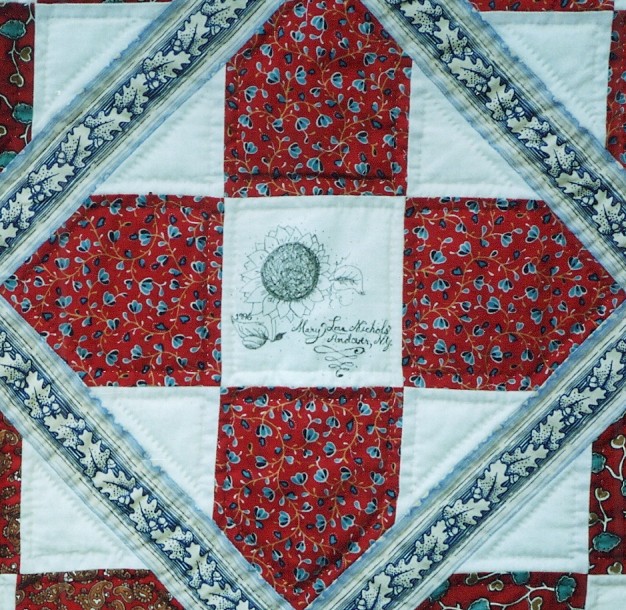

Mary Lou Nichols did a sunflower.


And Sylvia Morgenstern drew an Iris.

Natalie and I assembled the quilt in January and then turned it over to guild member Lois Griffith who added the backing and sent it out to be quilted. It was hand quilted by Mattie Hershberger, an Amish quilter in NY state. By the May meeting it had been returned and I put the binding on Memorial Day weekend. The quilt was done on May 30, 1997--label and all.

Guild member, Anna Lega, won the quilt at the June meeting. Lucky her!


__________________________
Copyright 2013, Barbara Schaffer


Monday, January 14, 2013

Samuel Bower - Not A Family Man

My maternal gr-grandfather, Samuel Bower, was born in Lawrence, MA, in 1858, married Irene McCord in West Farms, NY, in 1886, left his family in 1901, and died in 1913.


Sam Bower was the 5th child of English immigrants, Robert Bower and Phebe Marsland. In 1880 he was 22 years old living with his older brother, William and family, in Rhode Island. His occupation was "working for a printer."


He was Commander of Oliver Tilden Post #26 in NYC in January 1885 and again from 1892-98. Membership in the Sons of Union Veterans of the Civil War was open to any man who could prove his ancestry to a member of the Grand Army of the Republic or to a veteran eligible for membership in the GAR. Sam's father, Robert Bower, served in the Civil War with the 50th MA Volunteers from 1862-63.

During his term of office, he instituted the Vanderbilt Auxiliary, an organization open to wives, mothers, sisters and all female descendants of Civil War veterans, as well as widows, nieces, and grandnieces. Years later, his daughter, Leila Bower Kroepke would serve as its president from 1915-1917.


Sam married Irene McCord on November 4, 1886 at Grace Church in West Farms, Bronx, NY. He was 28 years old, she was 19. He gave her a gold wedding band engraved "1886." 


Irene Florence McCord, daughter of James McCord and Maria Miller, was born August 1, 1867. I believe this is her wedding photo. Her left hand prominently displaying a wedding ring :-)

Sam and Irene had two children, Stanton M. Bower (my grandfather) born 1888 and Leila Bower born 1890.


On the back of this c. 1895 photograph his daughter wrote: "Father, Samuel Bower, Uniform of Signal Corp." 


In the 1900 census the family was still together though Sam was unemployed. The following year he left home and never returned. Correspondence I had with relatives in the 1970s shed a little more light:

From Leila Bower Kroepke (his daughter), April 20, 1972:
"After Stan and Ethel were married and had Etta they got in touch with Samuel Bower and took the baby to see him - only once that I know of. I never saw him after he left home - until he died and was buried from Gleason Ave. Bronx . . .[my note: Stan and Ethel were my grandparents, Etta my mother. It's sad to think that my mother never knew her grandfather and that he never made the effort to stay in touch.]

From Josephine Bower Weeks (his niece), postmarked Feb. 24, 1979:
"When he [Sam] was sick with pernicious anemia, and he needed care, he lived with us for six weeks, thinking it would be a curative vacation, but was not so, as he died soon afterwards in New York. He was wonderful to me, I was his pet--and after he went back to N.Y. he sent me presents--one was a beaded bag, and, coming from N.Y., it was the envy of my schoolmates . . . Uncle Sam was a huge man, that is in height--I think he was well over 6 ft. He looked like my father, and, too, had many of the characteristics." [my note: this letter portrays a much more loving Sam Bower.]


In 1995 my Aunt Midge and I went to St. Michael's Cemetery in Astoria, Queens, NY. We knew the section, plot and # of Sam's grave so a very nice employee helped us find it by taking "giant steps" to pinpoint its exact location--between the two graves above. Unfortunately, there is no headstone. We were told it was probably buried when that section of the cemetery was cleaned up.

All in all, we were comforted in knowing that we finally "found him." I wonder if he "felt" the same about us.

As for Irene, she remarried but that is another story.

_____________

 Copyright 2013, Barbara Schaffer

Sunday, January 6, 2013

Benjamin W. Wooster R.I.P.

When we were in Albany, NY, the week before Christmas, I had made up my mind to spend some time at  Albany Rural Cemetery. There were times when I would take 200 photos at any given cemetery and then spend a month or two re-sizing and labeling them to post on Find A Grave. I was all prepared to take at least that many photographs when, after 30 or so, the memory card in my camera indicated it was FULL. Was I ever disappointed!


In large cemeteries I just wander and photograph gravestones that appeal to me. This monument with its graceful statue and three-dimensional ivy leaves caught my eye.


BENJAMIN W. WOOSTER
1819-1897
MARY E. STEELE
HIS WIFE
1822-1850
CATHERINE M.
WRIGHT
HIS WIFE
1830-1920

 
 Troy Daily Times, September 6, 1899

I found this ad in a local paper on Old Fulton NY Post Cards. This site is great for researching historical NY newspapers.
    

GEORGE T.
1853-1855
KATIE E.
1857-1860
RODNEY S.
1864-1866
CHILDREN OF
B.W. AND C.M.
WOOSTER

 EDWARD B.
SON OF
BENJAMIN W.
AND
CATHERINE M.
WOOSTER
1854-1944


HARRY GREEN
SON OF 
BENJAMIN W.
AND CATHERINE M.
WOOSTER
1867-1893


DAVID WOOSTER
1791-1844
POLLY WOODBURY
HIS WIFE
1794-1834

Monday, December 31, 2012

A Quilted Counterpane

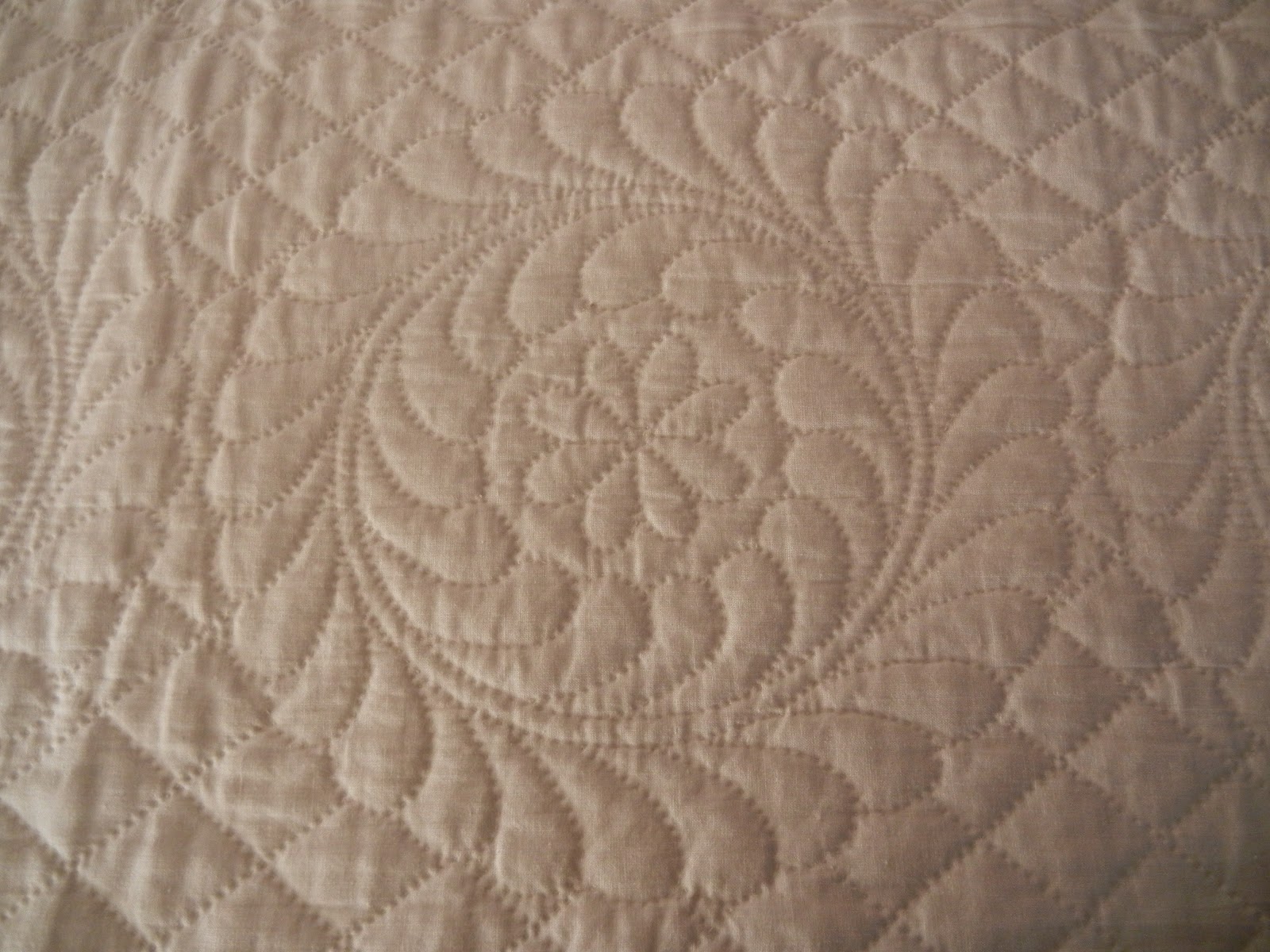
Once a year I pull out my one and only Quilted Counterpane and put it on the bed for the holidays. One morning I noticed that the lamp on our night table cast a light that was good for taking photographs so I grabbed my camera and snapped away. I couldn't get a good photo of the entire quilt because there were too many shadows but the detailed shots turned out quite well. 

   
.
In 1983 I entered the Tenth Annual Mountain Mist Quilt Contest sponsored by Stearns & Foster. Entries had to be based on Mountain Mist patterns and made with Mountain Mist batting. All fabrics had to be pre-washed and the quilt could not exceed 90" x 108." I chose Mountain Mist Pattern "Y" Quilted Counterpane. The diagram shown above was printed on the back of the batting wrapper and gave the placement of the feathered wreaths and vines.


I used a tracing wheel to punch tiny holes in the paper patterns and then "pounced" blue chalk powder over the holes to transfer the designs to fabric. 'Twas not an easy method!


There are twenty-four feather wreaths that surround the center medallion . . .


   . . . which has a single wreath surrounded by feathered vines.


More feathered vines run along the outside edges of the quilt. 


 The rest of the quilting is done in cross-hatch. This is a side view of the quilt.


My initials and the year are embroidered on the back. The quilt was selected as one of the 200 Finalist Entries to be displayed at the 1984 Quilt Market in Houston.

Quilt Market is still on my wish list :)


Wednesday, December 12, 2012

One Old, One New


In 1976 I made a quilt for my dad for Christmas. I used scraps I had from my high school days that were already 15 years old (!) and then purchased the red fabric for the border and an Ely and Walker print for the back.


I began by tracing around a template for each and every log and made the entire quilt top in three days. I tied the main portion with yarn and machine quilted the border in a diamond design. I gave Dad the quilt on Christmas Eve 1976 at my brother's house.


Sixteen years later, after my dad died, my brother took the quilt to his cabin in the Adirondacks where it was lovingly used until 1996 and desperately in need of repair. I brought the quilt home and appliqued new logs over the disintegrating ones. I still had some of the original fabrics in my scrap bag. Then early this year, my brother asked if I could please repair the quilt as it was literally falling apart. After taking one look at it I said it would be easier for me to make a new quilt than try and repair it - again!


My inspiration for this new quilt came from an article I saw in Quilter's Newsletter in 2002. I knew I wanted to use an Adirondack-style fabric for the border and a fishing-themed fabric for the back.


With that in mind, I decided to use all my leaf print fabrics for the Birds-in-Air blocks. I thought it would be really nice if I included fabrics that my mother had used in her quilts and applique pictures so all the solid  fabrics were hers.


I started making Autumn in the High Peaks in September. There were days when I sewed four blocks a day to keep on schedule. I finished the top in three weeks and had it machine quilted by someone in our guild.
 

Luckily my brother does not know how to use a computer so he will never know that I made this quilt for his birthday on the 27th :)


Tuesday, November 27, 2012

Quilt Sightings

Last month, friends and I spent a day traversing Union County, NJ,  visiting historic sites that were open to the public during their Four Centuries in a Weekend tour. I am always interested in colonial houses but when there are quilts on display, that's even better.


The mid-18th century Cannon Ball House, so named for a cannon ball lodged in the wall of the house during the Revolutionary War, survived being burned by the British in 1780. That's a huge flag in the front yard--part of a Civil War encampment that was going on during the open house. 


The first quilt sighting was a Bear's Paw quilt on a rope bed.  


The Salt Box Museum, named for  the sloping rear roof which resembles the box in which salt used to be kept, is actually two houses that were joined together in the mid-19th century.


A small bedroom in this house had a Log Cabin quilt on a rope bed and children's vintage clothing displayed throughout. 


The Littell-Lord House was built c. 1760 and had been owned and lived in for more than 100 years by the Lord family who purchased the site in 1867.


A Star of Bethlehem quilt was on the Victorian bedstead in an upstairs bedroom.


A Feathered Star/Sunflower Variation was displayed on a rack at the bottom of the stairs. 


The Caldwell Parsonage was rebuilt after the British burned it during the Revolutionary War.


 An unfinished Chimney Sweep hung in one of the rooms.


Only two of the blocks were signed and both were done in cross-stitch.
On the left:
Frances M. Lum 
Friendship's Offering
Feby 23d 1850

On the right:
Ann M. Woodruff


How's this for an original applique design?


The Woodruff House was built c. 1735 and had a 1930s applique quilt on a colonial cradle but I was more interested in the c. 1900 general store that was attached to the house.


There's just something about general stores that I absolutely love . . .


Perhaps it's because I have so many of these same items in my house :)