Wednesday, October 3, 2012

Charming Victorian Cottages

Last Saturday a friend and I went on a self-guided walking tour of the Victorian cottages in Mt. Tabor, NJ. This quaint village in the middle of suburbia was originally a Methodist camp meeting ground that was founded in 1869. Twenty-two structures were all within walking distance of each other and many were private homes that were open to the public. 


As we started on our walk this house caught my eye with its two large trees coming out of the porch roof. Don't you just love it?


This is a replica of a Camp Meeting Tent. The front portion was used as a parlor . . .


. . . and the back portion was sleeping quarters. There were two beds and each had a Log Cabin quilt.


When these three individual cottages were built they were joined "at the seam" to make the best use of the small tent lots facing Trinity Park, the center of all activity. The Mt. Tabor Historical Society acquired the cottage on the far right which was built in 1878. 


The interior has original stenciled walls.   


 Here's a detail.


On the other side of Trinity Park is The Mt. Tabor Library which has served the community since 1901. Its octagon shape represents eternal life.


Here is the children's section. Note the stenciling near the ceiling. 
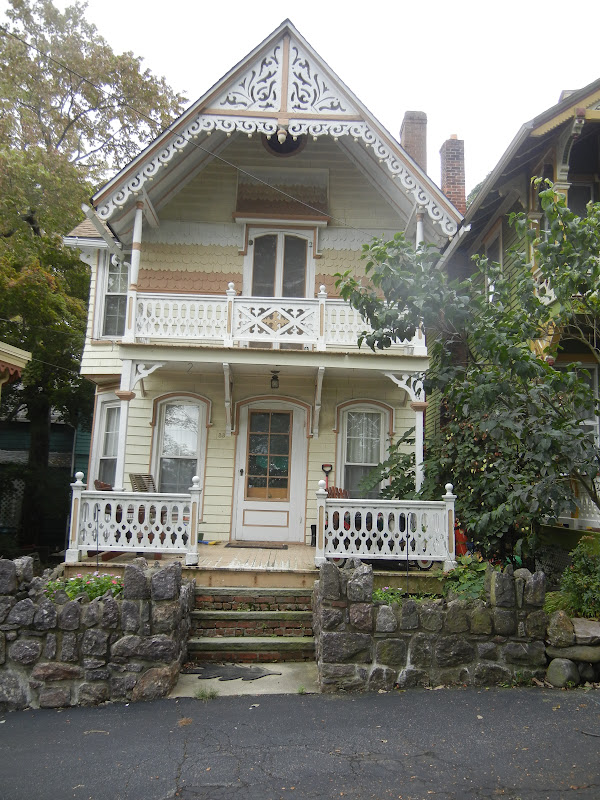


This lovely cottage with its ornate gingerbread trim is next to the library. When a house is purchased in the historic section, the land is leased, not owned.    
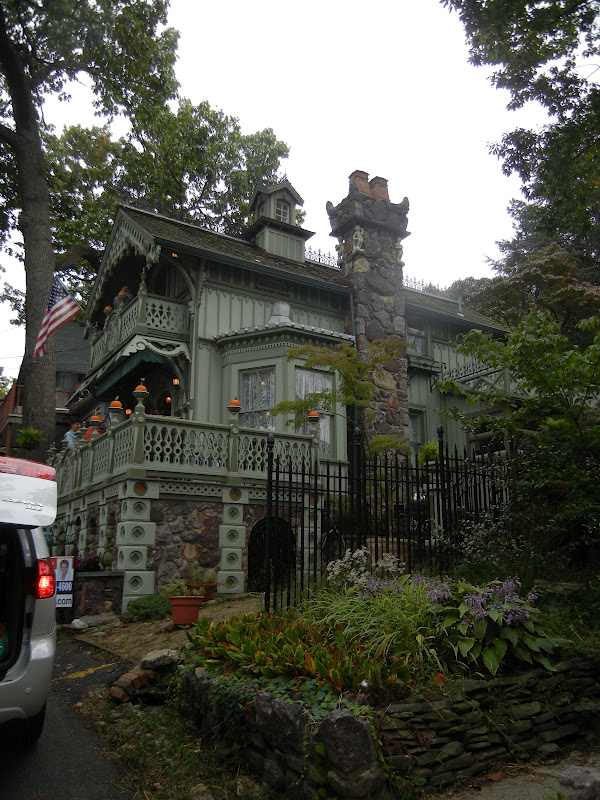

There were several cottages for sale including this one that was built c. 1879. It has been extensively remodeled. 


Many of the cottages are quite narrow. This one has three floors of living space. The kitchen and living room are on the second floor, bedroom on the third, and a "gathering room" on ground level.


This house built in 1875 was originally two small cottages. A kitchen was added in 1888. 


Another cottage with lots of gingerbread trim. The houses that surround the park have no garages or a place to park a car. Instead, there is a nearby parking lot that is available to these homeowners. 


Was I ever surprised when we went to look at this house--which is also for sale--that it is owned by someone I know from our local quilt guild. The house with its wrap around porch was built in 1907. Quilts are displayed everywhere--on walls, beds, and racks--and the downstairs sewing/craft room is ideal for quilts-in-progress. There is also plenty of storage space for a sizable fabric stash :) 


Friday, September 21, 2012

Great Lakes Seaway Trail War of 1812 Bicentennial Quilt Exhibit

This traveling exhibit of 1812 period-style quilts and interpretive panels really caught my eye at the PA Quilt Extravaganza, mainly because I love quilts that look old. The panels tell the stories of war, clothing, seamstresses, fabrics, sewing tools, and the possibility that the bedrolls the soldiers carried could have contained quilts from a loved one at home.


Soldiers' uniforms, made entirely by hand, were sewed by seamstresses who were required to complete a uniform in 1 to 1-1/2 weeks. 


You can read about the Great Lakes Seaway Trail Challenge here. The size of the completed panel had to be 30" x 70" but could vary 2" in both directions. Had I known about this challenge, I would have enjoyed making a panel as I love working with reproduction fabrics.  


George Brown's Quilt was made by Sally Wodell Stevens, Ellisburg, NY.  Sally designed her bedroll quilt using a modified version of the Star of Bethlehem which was known in the Philadelphia area. George Brown is the name of her 4th great grandfather who served in the Revolutionary War. 


Another interpretive panel and more quilts.


For Thomas is an original design made by Martha T. McCarthy, Londonderry, NH.  
 

Martha invented a story in the form of a letter written by a wife to her husband. It begins, "My dearest Thomas . . . I am concerned for your safety in this cold winter weather and have gathered fabric from friends to make this quilt. The center piece is from the bed curtains that your parents used. The back is fabric that I had planned to use for a dress and the others are pieces from many scrap baskets. . . "

Wasn't this a clever idea? 


I keep track of all military markers when I'm out and about photographing gravestones. I know I wrote about this marker once before but it still remains one of my favorites. Stephen Partridge was a casualty of the War of 1812 when he was killed in 1814 at the Battle of Plattsburgh, NY.  He is buried at Pleasant View Cemetery, Wilmington, NY.


David Hamilton died March 7, 1813 at the age of 32. He is buried at the First Presbyterian Church of Hanover in E. Hanover, NJ. The epitaph on his deteriorating gravestone reads:

In memory of
Capt David Hamilton
who died
March 7th 1813
aged 32 years and 11 months
My wife and child behold,
Your husband and your fathers fate,
And learn that you must die;
And do prepare before too late,
To live with God on high.
 

Major Stephen Young survived the War of 1812 and died Feb. 23, 1847 in the 56th year of his age. He is also buried at the First Presbyterian Church of Hanover.  


Driving home from PA we were at a rest stop on the NJ Turnpike when the setting sun lit up the sky.


Tuesday, September 18, 2012

PA National Quilt Extravaganza

Last Friday my quilting friends and I drove two hours to the PA Quilt Extravaganza in Oaks, PA. There were approximately 600 quilts, 22 special exhibitions, and 200 vendors. We ate lunch early to beat the rush at the food court and then began to work our way first through the special exhibits, then vendors and more quilts.


The first to catch my eye was this Color Values quilt made by Beth Nufer of Brookings, OR. It won 2nd Place in the Traditional Category. 


The quilt is 106" x 107" with over 300 fabrics and 4300 pieces. The solid color triangles appear to float on the surface. We really had to study the quilt to figure out her technique.    


Album of Roses was made by Rita Verocca of Thousand Oaks, CA. It is part of the World Competition XVI On Tour exhibition. It is an original design, hand appliqued, and hand quilted. It won a 2nd place ribbon in the Traditional Category.


The quilt measures 101" x 101".  This is a detail of the center upper right.


 And, here is a detail of the basket on the left side of the quilt. I turned the photo. 


 A Truly Feathered Star was part of the World Quilt Exhibition. It was made by Karen Sievert, Gainesville, VA. It won a 1st Place Ribbon.


The quilt is 74" x 74."  It's an original design, machine pieced, and long arm quilted. 
 

Best in Show was awarded to Theresa Fetch, Uvalde, TX, for her quilt Renaissance


This is an original design on cotton sateen and long arm quilted. After the quilt was bound, Theresa used Shiva paint sticks to add the iridescent silver to enhance the machine quilting. 


This is a detail of the center.


Waiting for the Mail by Mary Wilbur Wirchansky, Schenevus, NY, won Best of Country in the World Quilt Competition. I wish I had taken a photo of the back of the quilt. It is literally a scrapbook of family pictures and newspaper clippings.


Mixed Borders by Elisabeth Woodcock, South Africa, was an entry in the World Quilt Competition.


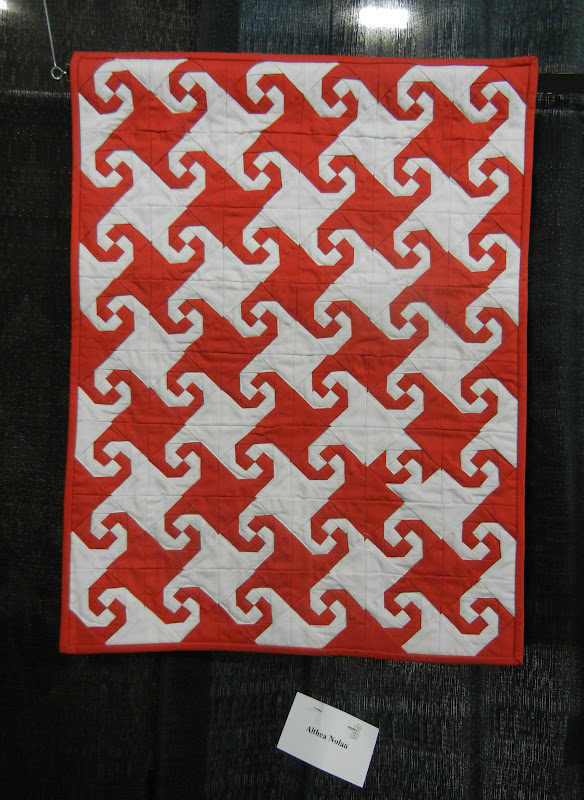
A Small Tribute in Red and White was a a special exhibition of quilts made by Northern Star Quilters' Guild, Somers, NY.


The guild issued an invitation to its members to make small quilts as a tribute to those who produced the Infinite Variety red and white quilt show in NYC.


I think I need to make a red and white quilt using solid fabrics in a repeat block design--just a small one :) 

More photos to come . . . 


Wednesday, September 5, 2012

Cute Needle Cases

I have a small collection of needle cases that I've either purchased, received, or made. They're kind of fun to look at every once in a while so thought I'd share them.


This cute little purse-shaped case has blanket-stitching along the edges. It was in a sewing tin that my Aunt Midge received from a friend. 


The inside is lined with flannel and filled with needles.

 
One of my favorites is this little crocheted hat with a ribbon bow. It reminds me of a sombrero.


The inside has a blanket-stitched felt piece for needles and a space in the crown for a thimble.


I think this is supposed to be a hat, don't you? It's made of red felt and embellished with a flower and leaves. The edges are pinked.


The inside is similar to the crocheted hat above with a hole for a thimble.


This little bonnet was no doubt made for "Thelma." The little tag with her name on it is held in place with a 1932 American Lung Association Christmas seal. There are silk ribbon ties. 


 The inside is unlined and has two muslin squares for needles. 


I'm quite sure I ordered a pattern for this needle case from Keepsake Quilting in the 1980s. I chose an Ely & Walker print for the outside . . .  


. . . and a solid red (looks pink here) fabric for the lining. I still use this case whenever there's a need to take some sewing along :)


This little needle case was made by my dear friend, Natalie Hart. It was a Christmas gift when we were working on our book about Florence Peto. I'm sure Natalie's inspiration was Florence's quilt, Playmates.


Note the little heart on the front and the same design on the inside for needles ~ and pins. There are two pockets for thread, scissors, templates, etc.


And, here's a University of Nebraska fabric needle case that was a favor at last year's American Quilt Study Group Seminar reminding everyone to attend this year's seminar--in Nebraska!

Make sure you visit Barb Vedder's blog, Fun With Barb. Last year she whipped up some spooky coffin needle cases. What fun!