Tuesday, June 26, 2012

The Wick House and Farm Garden

The Wick House and Farm Garden in Morristown, NJ, are maintained by the National Park Service. The house was built c. 1750 by Henry Wick, a Long Islander, who became the owner of 1400 acres in Morristown. The legend that continues to live on is about his daughter, Tempe, who in 1781 was stopped by several mutinied PA soldiers demanding that she give up her horse. She refused and galloped away. When the soldiers came looking for the horse they searched the barns and the woods, never thinking to look in the house. Tempe had put a feather bed on the floor to deaden the sound of the horse's hooves thus preventing the thieves from stealing her horse.   


The one-story Wick House was restored to near-original condition in 1934. During the Revolutionary War the house was open to Capt. Joseph Bloomfield (later 4th governor of NJ) who stayed there during the winter of 1776-77.


The kitchen with its large fireplace and wood plank walls. Even during the day, the house is extremely dark inside. 


Behind the kitchen are several rooms including this small bedroom with a rope bed, dresser, and chest. 


 The main room features Henry Wick's writing desk which dates to 1770. At one time two rooms were rented out to an officer and his aides who used them for their office, dining room, and bedrooms.  


This very small bed is in the same room as the desk.


The second bedroom also features a rope bed. 


A pair of lovely old latches on these interior doors.


The Wick Farm Garden sign.  

 This meticulously cared-for garden is to die for!


All plants are identified for their medicinal or culinary purposes. Marguerites were used for yellow dye.


Wild Marjoram was used for a "cooking seasoning." 


 One of my all-time favorites--Bee Balm :)


Monday, June 18, 2012

A is for Aprons

I've been collecting aprons for a long time and store many of them folded on a shelf in the laundry room. Every once in a while I'll go through the piles to see what's there--just for fun. My favorites, however, are hanging over the door in my sewing room. They are the embroidered aprons from the thirties.


This is our laundry room where I keep most of my collection. The curtain on the window is actually an apron and the valance is an embroidered tablecloth folded in quarters and hung over a rod. I made the small quilt from vintage tablecloth scraps that a friend sent me from CA. 


Here is a full view of the apron "curtain" with a patchwork waistband, ties, pocket, and decorative lower edge.


This full embroidered apron has straps that criss-cross in the back and fasten on both sides with snaps.  There are no pockets.


Here is a detail of the embroidered floral basket. Lots of black floss used in this design.


A full bodice and flared skirt trimmed in blue.


The scalloped design is embroidered in blanket stitch; the horizontal lines in outline stitch.


I love this skirt with its dainty flowers and large scallops.


This half apron is gathered at the waistband with embroidery at the lower edge. Most likely from the 40's--or even the 50's.


Lovely shades of aqua, pink and green. Note the pink and white gingham fabric above and below the embroidery.


Another full apron with lots of blue and yellow embroidery. All the outer edges are top-stitched by hand using yellow floss.


Heavily embroidered blue flowers with yellow 'x's scattered throughout the lower portion.


A child's apron with embroidered figures a la Sunbonnet Sue--or is it Colonial Lady--or something else??


And here is my grandmother, Etta Strubbe Bower, as I remember her. Always wearing an apron and always in the kitchen making something good to eat. (c. 1950s)


Monday, June 4, 2012

Hello Darlin'

Every time my great Aunt Leila and Uncle George came to NJ for a family gathering, Uncle George would greet me with a big "Hello Darlin'!" I just thought about that the other day and had to laugh as it seemed so out of character for someone who lived his entire life in the Bronx, NY. Thanks to Aunt Leila for saving oodles of family memorabilia, I thought it would be nice to honor Uncle George for his military service during World War I.


On May 17, 1918, George received his orders to report for active duty at Newport, RI. He was 27 years old.


He had a slight build and was only 5' 5-1/2" tall. 


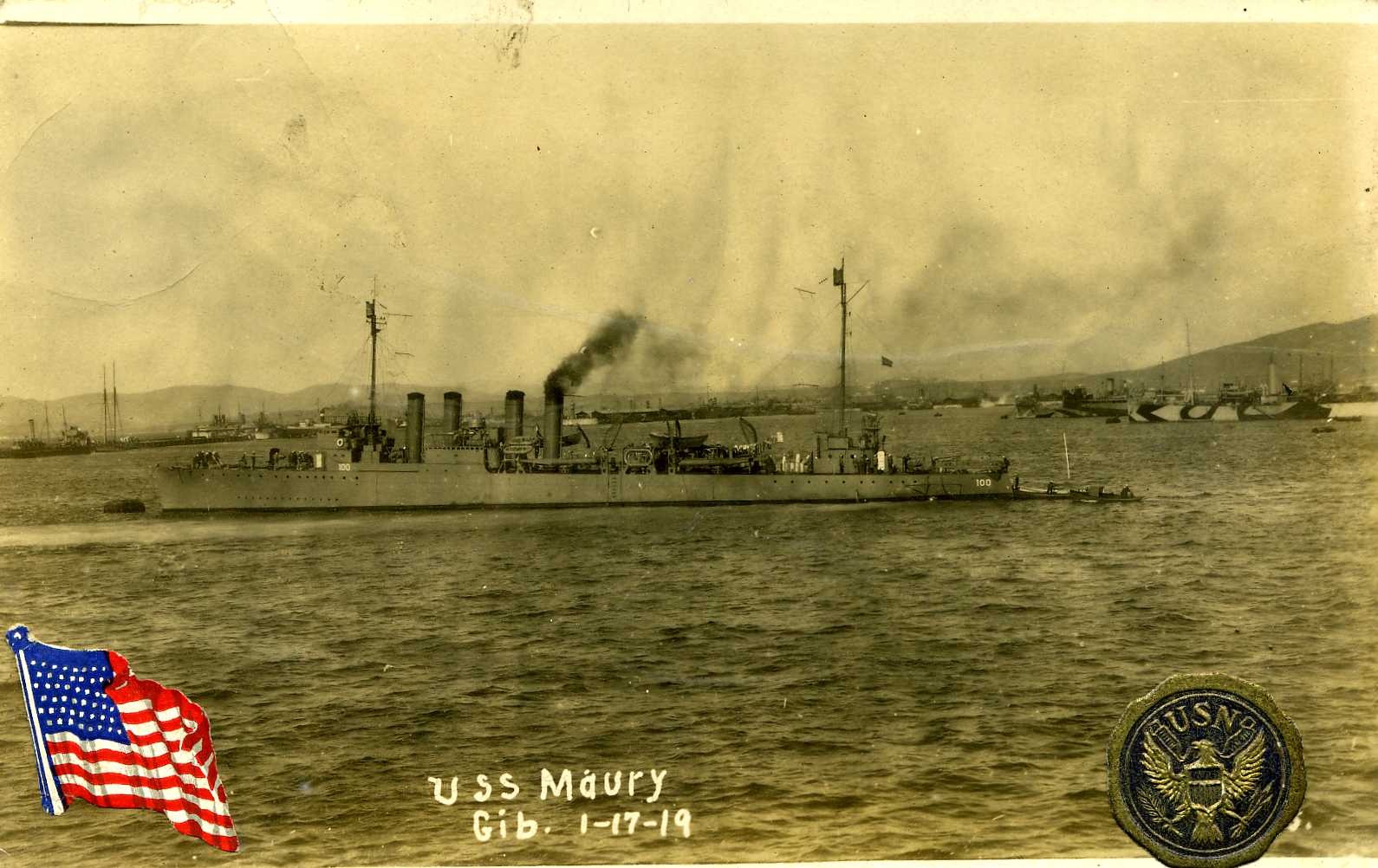
Dated Feb. 1, 1919, Gibraltar. "My home for the present. U.S.S. Maury, Torpedo Boat Destroyer No. 100, U.S.N.  Length 315 ft.; breadth, 30 ft.; Heigth [sic] from water to deck at bow, 12 ft; Heigth [sic] from water to deck at stern, 6 ft; Power - two curtiss turbine engines, 27,000 hp; Steam plant - four tubular marine boilers; Speed with two boilers - 27 knots; Speed with four boilers - 39 knots; Armed with four 4-inch guns; Armed with two one pound anti air craft guns; Armed with one depth charge Y gun; Armed with two depth charge racks; Armed with four triple torpedo tubes, 12 torpedoes; Crew of 130 men - destroyer sailors. I am yours truly, one small spud. George"


George was assigned to the 3rd Section of the Landing Force. 


"We're paid in currency of whatever port we were in. In Turkey we received gold coin and exchanged $5.00 gold for $7 in American money."


Dated Dec. 2, 1918. Dear Leila, I am sending you this now and hope you receive it before Christmas or New Years and hope you have a Merry Christmas and Happy New Year and better still I hope I can wish this to you personally by that time. Be happy dear and I'll see you soon. George"


One of several postcards that George acquired on his travels.

 
Dated Jan. 1, 1919. "Hello Toots: I don't know what it says or means on the other side of this postal, but I guess it's allright. Be good dear. Georgie xx."

Uncle George and Aunt Leila on their 55th wedding anniversary, June 1, 1973. Mayor Alfred B. DelBello sent a letter of congratulations on behalf of the City of Yonkers. How times have changed :)


Sunday, May 20, 2012

Heirloom Irises

The Presby Memorial Iris Gardens in Montclair, NJ, are in full bloom with more than 14,000 irises in 26 flower beds. The gardens were named for Frank H. Presby, a horticulturalist, and founder of the American Iris Society. There are many different varieties including heirloom, bearded, and hall of fame, dating from 1600 to the present.


 One of the beautiful iris beds as you enter the gardens.


The label: 1612. I. Swerti.


1935. Madame Maurice Lassailly.


 1860. Albicans.


2000. Celtic Glory.
 

2004. Secondhand Rose.


2000. Royal Storm.


Unidentified bearded iris.


1884. Gracchus.


1500. Florentine Blue.


1985. Oktoberfest.


1987. Fringe of Gold.


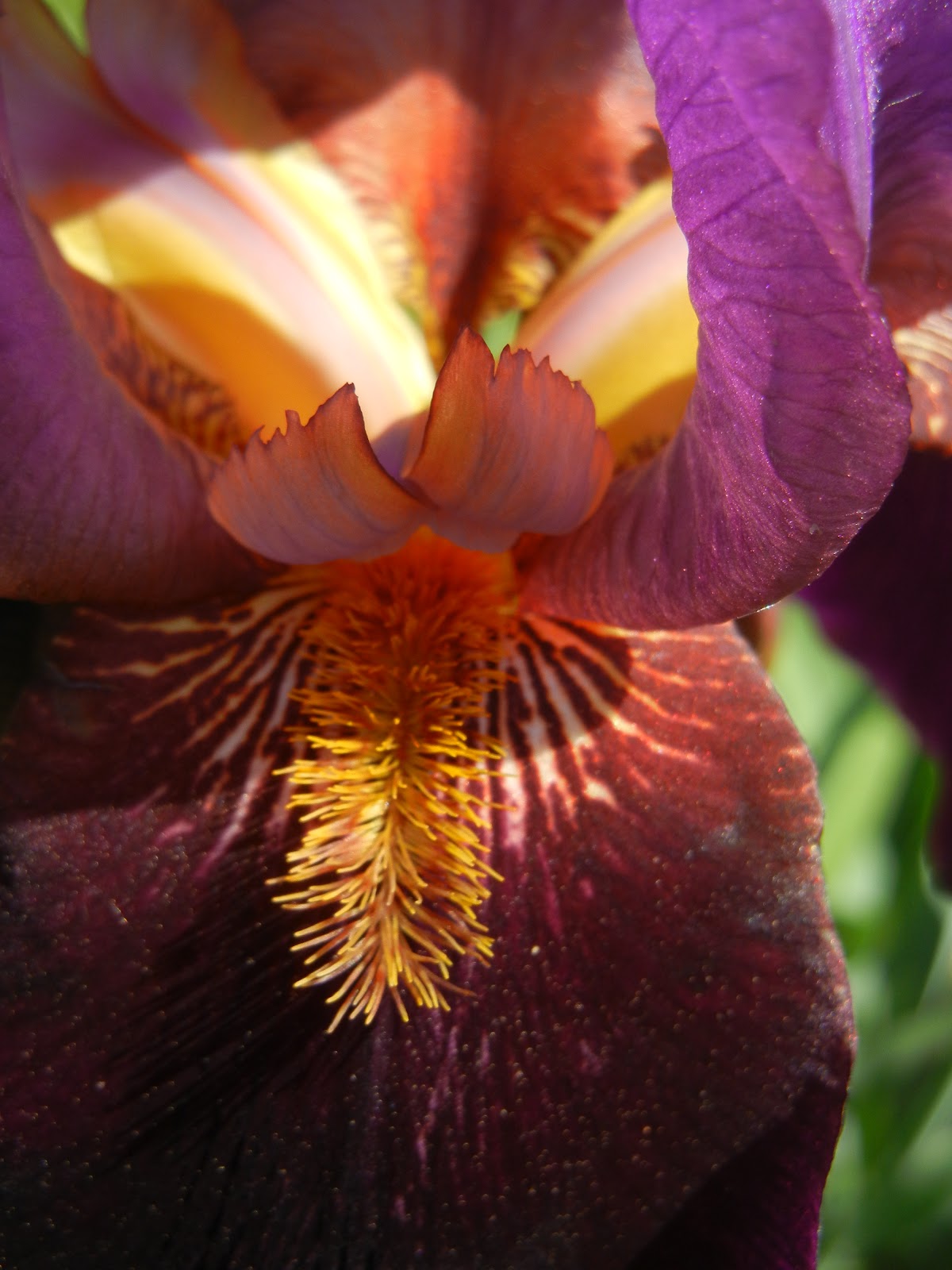
And, here is one from my garden :)


Thursday, May 3, 2012

Aerial Views I, II, and III

All it took was one cloudless day to set the wheels in motion to design a quilt of the land formations that I saw as I flew cross-country from CA to NJ. I began sketching designs of the mountainous regions of the west, then the plains of the midwest, and finally the more congested areas of the east coast. In one year (1986-1987) I made three 45" x 90" panels--Aerial View Part I: Hands Across the West, Aerial View Part II: Hands Across the Midwest, and Aerial View Part III: Hands Across the East. The "hands" part of each title was influenced by the Hands Across America event that took place nationally in 1986.


What I thought was going to be one quilt became three large panels which I designed on graph paper. Fabric samples are pinned along the lower edge.


Aerial View Part I: Hands Across the West. Each panel is made of wool and corduroy with a poly-fil batt and muslin backing. From my scribbly notes I initially thought of using ultra suede and chamois cloth for the softer hues and padding the mountain with old panty hose for a 3-D effect. What was I thinking?? Ultra suede was too expensive so I ended up purchasing lots of wool samples at a nearby fabric outlet and I didn't pad the mountain :) In 1986 this panel was included in the New Jersey Arts Annual: Fiber, Metal & Wood exhibition at the New Jersey State Museum in Trenton.


I asked co-workers, friends, and my son, daughter, and husband, to do paper tracings of their hands which I then used as quilting patterns to carry out the Hands Across America theme. My dad's hand is in the upper right :)


Aerial View Part II: Hands Across the Midwest. The simple outer border was made from leftover wool scraps.   


Flying over Nevada, Utah, and Colorado, then Nebraska and Iowa, the colors of the landscape changed from browns and grays to rusts and greens and the lay of the land was less square and more curved. That's a major highway leading in on the lower left.


The quilting pattern I used in the second panel was a chain of figures in diagonal rows. Single figures were quilted in the border blocks and all the quilting was done by hand.


  Aerial View Part III: Hands Across the East. My notes say " Ohio/PA, help! cloudy!"


The landscape was looking a little more dense as we approached the east coast. The city streets of Chicago are represented by the small grids on the left and there's Lake Michigan. Flying over OH, PA, and NJ, the fall foliage was beautiful. There were small lakes, farmlands, and neighborhoods with baseball fields. Then came the NJ Turnpike with freight yards, storage tanks, and industrial areas. And before I knew it we had landed. That was probably the fastest cross-country flight I had ever taken. I kept myself occupied the entire trip sketching and thinking of how I was going to make a quilt--and couldn't wait to get started!